

ISO 9001:2026 Quality Management System (QMS) certification
QMS certification and training from industry experts
How ready are you for ISO 9001:2026?
Assess your current readiness, identify potential gaps and understand where to focus as you prepare for transition to the revised standard.
ISO 9001:2026 Self-Assessment Tool
Assess your readiness with our free tool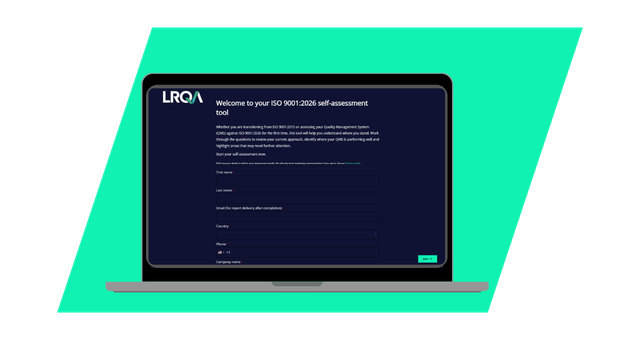
Turn ISO 9001: 2026 requirements into stronger business performance.
In a world shaped by complex risks and fast-changing demands, quality must go further than compliance.
ISO 9001 certification is the globally recognised standard for Quality Management Systems (QMS).
At LRQA, we help you embed ISO 9001 as part of a connected risk management approach, improving operational performance, building resilience and unlocking competitive advantage. From certification and training to insight and improvement, our experts partner with you to manage what matters most.
ISO 9001 standard is currently being revised, along with ISO 14001 and ISO 45001. The final updated standards are expected in 2026, triggering a three-year transition period. Now is the ideal time to evaluate your readiness and strengthen your management systems for the future. To support you, we’ve launched the LRQA Transition Club, a free resource hub designed to keep you informed and prepared. Register now to stay ahead.
Check out the Frequently Asked Questions for information about the ISO 9001 standard and our solutions.
To support you, we’ve launched the LRQA Transition Club, a free resource hub designed to keep you informed and prepared. Register now to stay ahead
What is ISO 9001?
ISO 9001 is an international standard for quality management. It helps organisations improve their processes, meet customer needs, reduce errors and consistently deliver products and services that meet quality and regulatory requirements.
OFFICIAL TRANSITION TIMELINE
Your ISO 9001:2026 transition journey
From publication to ISO 9001:2026 certification
ISO 9001:2026 published
The revised standard is published and the formal transition period begins.
16 SEPTEMBER 2026

Early adoption begins
Organisations ready to move early can begin transition assessments against ISO 9001:2026.
FROM PUBLICATION

New certification to ISO 9001:2015 ends
New certification activity moves to ISO 9001:2026 as the transition progresses. *Estimated March 2028
18 MONTHS AFTER PUBLICATION*

Transition window closes
Organisations certified to ISO 9001:2015 must have completed their transition to ISO 9001:2026.
30 SEPTEMBER 2029

Five steps to a successful ISO 9001:2026 transition
Understanding the changes
Review the revised requirements and understand what they mean for your QMS, people and processes.
ONE
Assess where you stand
Review your existing QMS to understand what already aligns and where changes, additional evidence or greater clarity may be needed.
TWO
Build your transition plan
Prioritise the changes you need, assign responsibilities and timings, and align transition activity with your existing management system and audit programme.
THREE
Implement changes and build capability
Put the required changes into practice and make sure leaders, quality teams and relevant process owners understand the revised requirements.
FOUR
Verify and complete your transition
Use internal audits, management review and performance data to check that changes are working, address any remaining gaps and complete your transition assessment against ISO 9001:2026.
FIVE
Ready to start your ISO 9001:2026 transition?
LRQA can help you understand the changes, assess your readiness and plan a smooth transition to ISO 9001:2026.
NEXT STEP
Start your transitionWhy is ISO 9001 certification important for Singapore organisations?
ISO 9001 certification in Singapore shows that your organisation follows a consistent, high-quality, independently verified approach to delivering products and services. It codifies best practices into documented processes, so every team follows the same standards, reducing errors and rework. Certification signals to customers, regulators, and partners that your quality management system (QMS) has been audited against a globally recognised benchmark — not just self-declared. In industries where suppliers must hold ISO 9001 approval to bid, certification opens doors to new contracts and markets across Singapore.
What are the benefits of ISO 9001 certification?
- Competitive advantage — Many organisations require suppliers and partners to hold independent ISO 9001 certification as a license to tender. While not always contractually mandatory, certification consistently strengthens credibility and helps win and retain trusted business relationships.
- Business effectiveness and performance — ISO 9001's best-practice principles improve risk management, clarify internal and external business context, and lift overall performance. Accredited certification through a globally trusted provider like LRQA is a mark of credibility and professionalism worldwide.
- Easy integration with other standards — ISO 9001 follows the Annex SL framework, the high-level structure for modern ISO Standards, enabling straightforward, harmonised implementation across an integrated management system. It integrates easily with ISO 14001, ISO 45001, and ISO 27001.
- Stronger risk management — ISO 9001's risk-based approach helps identify and address operational risks before they become costly failures, giving leadership clear, evidence-based visibility into organisational exposure.
- Higher customer retention — A documented, consistently applied QMS reduces errors and rework, directly improving customer satisfaction and repeat business over time.
- Employee engagement and clarity — Clear, documented processes give teams a shared understanding of roles, responsibilities, and quality expectations, reducing the ambiguity that drives errors and disengagement.
How do you get ISO 9001 certification in Singapore?
Getting ISO 9001 certified in Singapore follows a structured, five-stage journey — from an initial gap analysis to ongoing surveillance audits — designed to ensure your QMS meets global standards. Most organisations complete the full process in 6–12 months, depending on the maturity of their existing systems.
LRQA's ISO 9001 Certification Process
1. Gap Analysis & Preparation
- Map your existing quality procedures against ISO 9001 requirements.
- Use an ISO 9001 audit checklist to identify gaps in documentation, work instructions, processes, and quality records.
- Build a targeted action plan — updating procedures, assigning responsibilities, and training staff to close compliance gaps.
2. Implementation & Internal Review
- Roll out the revised processes across your teams.
- Run a full internal audit (or mock assessment) to test QMS effectiveness.
- Confirm employees understand new procedures and that records like audit logs and corrective action reports are accurately maintained.
3. Stage 1 Audit (Documentation Review)
- Submit your QMS documentation for remote review by the certification body.
- Auditors examine your quality manual, process maps, and records against ISO 9001's clauses.
- Resolve any minor non-conformities early to prepare for the main evaluation.
4. Stage 2 Audit (Implementation Evaluation)
- Auditors observe your processes in action, on-site or remotely.
- They interview staff, inspect records, and verify documented procedures are followed in practice.
- Address findings promptly to demonstrate commitment to the standard's requirements.
5. Certification & Ongoing Surveillance
- On successful completion of both audit stages, you receive your ISO 9001 certificate, valid for three years.
- Annual surveillance audits confirm your QMS remains effective and compliant.
- These recurring reviews also surface fresh opportunities for efficiency gains and risk mitigation.
CONSIDERING A CHANGE?
Transition to the new standard with LRQA
Your ISO 9001 transition is a natural point to review your certification partner. If your certification is currently with another provider, LRQA can manage the transfer, coordinate your next audit and take care of the key dates and details. If you hold multiple standards, we can also explore bringing them together under one aligned plan.
What has changed?
ISO 9001:2026 is an evolution of the existing standard rather than a complete redesign. Its updates are intended to improve clarity, strengthen quality leadership and keep quality management aligned with the way organisations operate today.
-
Clearer requirements
Updated language and clearer requirements are designed to make the standard easier to understand and apply consistently across different organisations and sectors.
-

Greater emphasis on leadership and quality culture
The revised standard strengthens the connection between leadership, accountability and a culture that supports quality throughout the organisation.
-
Clearer treatment of risks and opportunities
ISO 9001: 2026 provides greater clarity around how organisations identify and address risks and opportunities as part of planning and decision-making.
-
New Annex A guidance
A new Annex A provides additional clarification around key concepts and their intent behind requirements, helping organisations interpret and apply the standard.
-

Closer alignment with other management system standards
The revision supports greater consistency with other ISO management systems standards, helping organisations that manage quality alongside areas such as environmental management and occupational health and safety.
Where to focus now?
Publication starts the transition, but it does not mean rebuilding your Quality Management System from the ground up. Start with the system you already have, understand where the revised requirements affect it and focus your effort where change will add value.
Get the right people involved
Make sure leadership, quality teams and relevant process owners understand that the standard has changed and what the transition means for their responsibilities.
STEP ONE
Review your existing QMS
Look at how effectively your current management system is working before making changes. Strong existing processes may already address many of the revised expectations.
STEP TWO
Compare against the new requirements
Use self-assessment or gap analysis to identify where your system already aligns and where changes, additional evidence or greater clarity may be required.
STEP THREE
Review risks and opportunities
Consider whether your existing approach reflects the clearer expectation of ISO 9001:2026 and whether risks and opportunities are being used effectively to support decision-making.
STEP FOUR
Build understanding across your organisation
Give the people responsible for implementing, maintaining and auditing your QMS the knowledge they need to work effectively with the new standard.
STEP FIVE
Plan, implement and verify
Prioritise the changes you need, assign responsibilities and build transition activity into your existing management systema and audit programme.
STEP SIX
Build your transition plan
Move from understanding to action with LRQA. We support your transition journey with a range of tools to help you understand readiness and build the capability you need.
Assess readiness
Build an initial picture of how your current QMS aligns with key areas of the revised standard and identify where further investigation may be valuable. Use your results to help focus your next steps and priorities.
Take the ISO 9001: 2026 self-assessment
Validate gaps
Get a view of your readiness. Gap analysis compares your existing management system with the revised requirements and helps you prioritise activity before your transition audit.
Explore LRQA’s Gap analysis checklist
Build capability
Understand the changes and what they mean in practice. Our ISO 9001: 2026 training helps quality professionals, auditors and wider teams build the knowledge needed to support transition.
Explore ISO 9001: 2026 training
Complete your transition
When you’re ready, our auditors can assess your Quality Management System against ISO 9001: 2026 and support your move to certification under the new edition.
Talk to us about your transition
Our ISO 9001 Services
Our team of expert auditors is here to be your partner at every stage of your ISO 9001 certification journey. They can help you demonstrate your commitment to best practices through globally recognised quality management system certification, enhancing your credibility and reliability in the market. Whether you’re starting from scratch, refining an existing QMS, or preparing for the transition to the 2026 version, LRQA offers sector-specific insight, local delivery, and global consistency.
Accredited certification
An independent two-phase approach that provides a clear statement of your capabilities. Accredited certification helps you build trust with stakeholders and win new business.
Training
Expand your knowledge of ISO 9001 with our range of courses that have been designed for varying levels of experience and learning styles.
Gap analysis
An optional service where one of our expert auditors helps you identify any weak areas or non-conformities prior to your formal ISO 9001 audit.

Integrated audits
In cases where your organisation holds multiple management system certifications, we offer an integrated audit and surveillance programme, allowing you to streamline your processes and ultimately leading to more efficient and cost-effective management systems.
Managing More Than ISO 9001?
If you also hold ISO 14001, ISO 45001 or other certifications, transition is a useful time to consider whether your management systems could work better together. An integrated approach can reduce duplication, align shared processes and make audit activity easier to coordinate.
Explore integrated management systems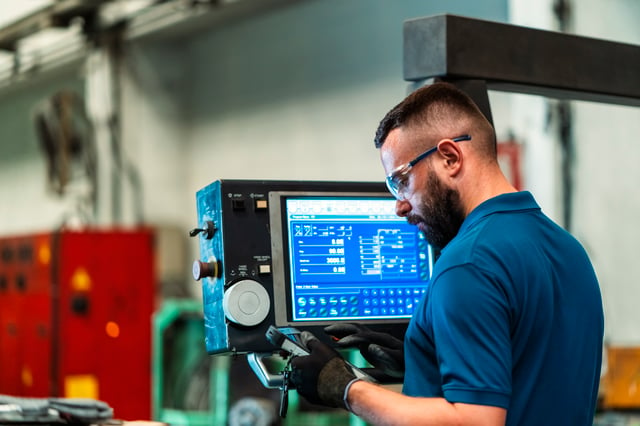
Why work with us?
Global reach, local support
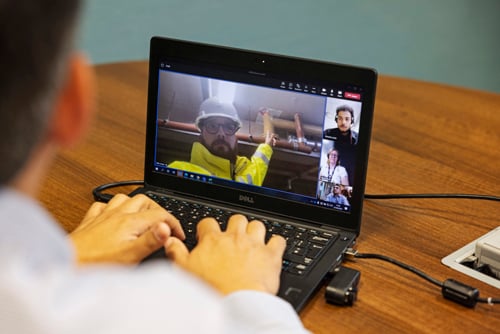
With clients in over 150 countries and auditors on the ground wherever you operate, we deliver consistent quality and responsive support worldwide, both in person and remotely.

A connected approach to risk
ISO 9001 is a powerful foundation for managing quality and driving improvement. At LRQA, we help you build on that foundation by connecting it with wider business risks, from safety and sustainability to cyber and supply chain, giving you a clearer, more complete view of performance and resilience.
Decades of expertise
LRQA was the first to achieve UKAS accreditation to deliver certification services across multiple standards worldwide. With decades of sector-specific experience, our auditors tailor every audit to your industry, operations and goals.

Focused on you
Our approach is always tailored to your goals. Whether you’re aiming to meet client expectations, access new markets, improve efficiency or support growth, we help you get there, with risk management solutions you can trust.

Join the ISO Transition Club
The LRQA Transition Club brings together our latest ISO 9001:2026 guidance and resources so you can keep up with the transition and understand what to do next.

Expert guidance on ISO 9001:2026

Practical guides, FAQs and explainers

Self-assessment and gap analysis resources

Transition planning support

Webinars and training

New resources throughout the transition period
ISO 14001:2026 live. ISO 9001 FDIS live, and ISO 45001 DIS coming soon.
The world’s most recognised management system standards are being updated, with new requirements, new expectations and a formal transition period on the way. These changes matter.
ISO Transition Club: It's Free to Join
Are you ready to respond? Join our Transition Club.
CASE STUDIES
-
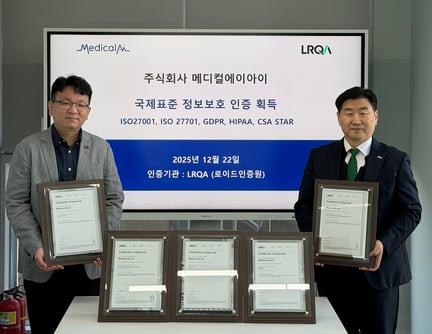
Medical AI Case Study: Building a Trust-Based Security Framework
Case Study
Medical AI, a healthcare AI company, partnered with LRQA to achieve five information security certifications and verifications, including...
Read more -
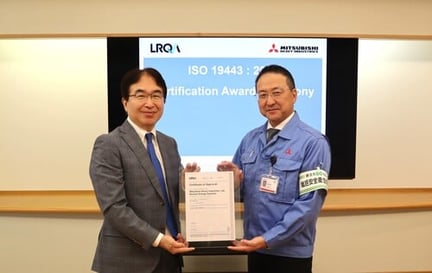
LRQA Awards ISO 19443 Certification to MHI
Case Study
Learn how LRQA awarded ISO 19443 certification to Mitsubishi Heavy Industries (MHI), marking a significant milestone in nuclear...
Read more -
KSB SAS: Strengthening Nuclear Safety Culture with ISO 19443

Case Study
Learn how KSB SAS partnered with LRQA to strengthen its nuclear safety culture and ensure compliance. Explore their...
Read more -
Serco's Journey with LRQA: Strengthening Business Resilience

Case Study
Learn how Serco partnered with LRQA to strengthen resilience, optimise operations, and ensure compliance. Explore their journey and...
Read more -
EHS Achieves ISO 42001 AI Management System Certification with...

Case Study
Emirates Health Services becomes the first to achieve ISO 42001 AI Management System certification with LRQA, emphasizing AI...
Read more -
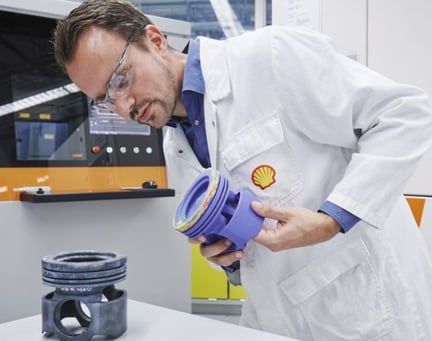
Shell: 3D printing quality assurance case study
Case Study
LRQA is supporting Shell with assurance solutions for safety-critical 3D printed parts, driving trust and innovation in additive...
Read more
Latest news, insights and upcoming events
-
AI Penetration Testing for ISO 42001 Compliance

Article
ISO/IEC 42001 sets the framework for responsible AI management, but documentation alone does not prove your controls work....
Read more -
The quality mindset: Connecting risk, culture and performance to...

Article
In celebration of World Quality Week, LRQA’s latest Future in Focus podcast brings together two of our leading...
Read more -
ISO 9001:2026 is live: the transition period has begun...

News
ISO 9001:2026 has been published, starting the three-year transition period. Whoever your certification body is, take the first...
Read more -
ISO 9001 revision update: Publication date confirmed
News
The publication date for ISO 9001:2026 has been confirmed as 16 September 2026, marking the start of the...
Read more -
Integrated vs Consolidated Management Systems: Why the difference matters

News
Learn the difference between integrated and consolidated management systems, when each approach works best, and how organisations can...
Read more -
LRQA achieves UKAS accreditation for ISO 42001, strengthening assurance...

News
LRQA has achieved UKAS accreditation for ISO/IEC 42001, enabling accredited certification for AI management systems. This strengthens assurance...
Read more -
LRQA launches global grievance mechanism dashboard

News
Explore LRQA’s interactive grievance dashboard for near real-time insight across supply chains, supporting consistent categorisation, trend analysis and...
Read more -
IATF 16949 update: aftermarket replacement parts now in scope

News
New IATF scheme interpretations confirm eligibility for aftermarket replacement parts and require their inclusion in scope for mixed...
Read more -
APAC ISO 9001:2026 - Key Audit Findings and What...

Event
Join the LRQA webinar to understand ISO 9001 audit findings, what the new standard means for you, and...
Read more