

EU Forced Labour Regulation (EUFLR)
Practical guidance covering what it means, how it works and how to prepare
Forced labour is a global human rights crisis that affects multiple regions and sectors. It includes state-imposed forced labour documented in contexts such as the Xinjiang Uyghur Autonomous Region in China and in Turkmenistan's cotton sector; these examples illustrate why governments are increasingly turning to market restrictions to reduce the economic incentives that allow forced labour to persist.
The EU Forced Labour Regulation (EUFLR) is a product ban regulation introduced by the EU Commission. It prohibits economic operators from placing, making available, or exporting products made with forced labour on or from the EU market. This includes online sales targeting EU consumers. Crucially, the regulation is investigation-based: products are not automatically withheld at the border, but are subject to a structured, multi-step investigative process. Unlike the US Uyghur Forced Labor Prevention Act (UFLPA), , which assumes forced labour at the border unless proven otherwise, the EUFLR puts the responsibility on the authorities to prove a violation.
This hub brings together practical guidance on what the EUFLR requires, how investigations and enforcement will work in practice, and what organisations can do to prepare. Through a series of articles and updates, it explores both response readiness and forced-labour-sensitive due diligence. With Commission guidance now available and the regulation applying from 14 December 2027, organisations have a clearer framework for action, but preparation should begin now.
4 Key learnings for businesses
Explore four key learnings from the EUFLR guidelines in our infographic, covering investigations, structured risk identification and focused responses to significant risks. Discover why due diligence must lead to action and what businesses can do to strengthen readiness and provide credible evidence.
Download the infograph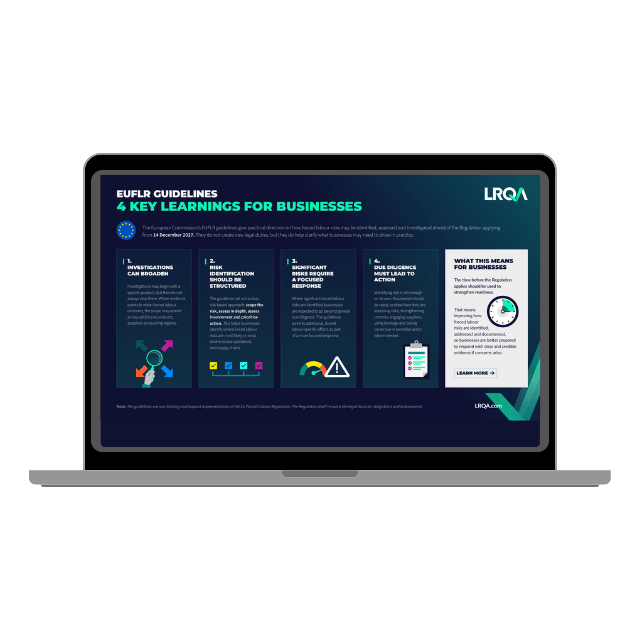
Understanding the EUFLR: the essentials
Explore how the EUFLR works, who falls within its scope and how its investigation-led approach differs from other forced labour regulations. Review and examine the key uncertainties organisations should be aware of and why early preparation matters.
Understanding the essentials
LRQA's stance on EUFLR Readiness
Explore the essential dimensions of EUFLR readiness: the ability to respond quickly and credibly to an investigation, supported by due diligence and product-level evidence. See how investigations may be triggered, what authorities expect and where organisations should focus preparation.
LRQA's stance on EUFLR readiness
What companies should do now
Discover the practical steps organisations can take now to prepare for EUFLR enforcement. Focus on building effective investigation response processes and making existing due diligence systems more sensitive to forced labour risks.
What companies should do now
EU Forced Labour Regulation guidelines:
Explore how the European Commission’s EUFLR guidelines clarify risk assessment, investigations and the evidence businesses may need to provide. Understand how to strengthen readiness through clear documentation and targeted action.
EU Forced Labour Regulation guidelines
Broader forced labour insights
Explore wider perspectives on forced labour regulation, from the growing impact of import bans on global market access to LRQA’s recommendations on the practical implementation of the EUFLR.

How LRQA can help
Management review and gap analysis
A structured assessment of your existing due diligence systems against EUFLR requirements and best-practice frameworks, identifying priority gaps and practical next steps.
Investigation response simulation
Facilitated tabletop exercises that simulate a realistic EUFLR investigation scenario, from trigger submission through preliminary and formal investigation stages. These exercises stress-test your response readiness, identify gaps, and build team capability before an investigation is ever triggered.
Forced labour investigation and crisis support
Expert support for companies that receive a notification from a competent authority, including rapid evidence review, documentation preparation, communication strategy, and coordination with authorities throughout the investigative process.
Programme design: forced-labour-sensitive due diligence
Design and implementation of forced-labour-sensitive due diligence programmes, integrating forced-labour risk indicators into existing HRDD or responsible sourcing systems and building the product-level lens and traceability capabilities required under EUFLR.
Forced labour on-site insights
Specialist on-site assessments designed to go beyond standard social audits, combining forced-labour-specific indicators, independent worker interviews, and operational analysis. LRQA's assessments are structured to identify the patterns that standard audits typically miss, including demographic risk factors, recruitment pathway analysis, and indicators of coercion.
Independent worker voice and grievance mechanism design
Design and deployment of worker voice mechanisms that genuinely reach workers, including independent off-site interview programmes and confidential grievance systems with demonstrated case handling outcomes.
Risk analysis and supply chain mapping
Using LRQA's EiQ platform and Sentinel risk scanning system, we provide a data-driven foundation for forced-labour risk identification, supply chain mapping, and prioritisation, enabling organisations to focus their resources where exposure is greatest.
CSDDD alignment
Support for integrating EUFLR preparedness into broader CSDDD-aligned HREDD systems, ensuring that compliance investments are shared across regulatory obligations rather than duplicated.
Remediation support
LRQA has accompanied multi-year forced-labour remediation programmes, including recruitment fee repayment in the APAC region, wage restitution, and victim-centred case management. We support organisations from initial investigation through to verified remediation completion.
About the authors
Jens Winkler
Jens Winkler leads LRQA’s German sustainability consulting team and has more than 15 years of experience in responsible sourcing and human rights due diligence. He supports organisations in developing supplier monitoring systems, audit programmes and practical approaches to supply chain risk. Jens has advised clients across food retail, automotive, FMCG and pharmaceuticals, contributed to the German government’s National Action Plan monitoring and supported the Responsible Supply Chain Initiative. He is also a certified SA8000 Lead Auditor with experience in social audits and investigations across European supply chains.
Contact Jens
Matthias Wiedekamp
Matthias Wiedekamp is a Consultant in LRQA’s EMEA sustainability team, specialising in human rights due diligence, responsible sourcing and supply chain compliance, with a particular focus on the EU Forced Labour Regulation. He advises multinational organisations across apparel, automotive, cosmetics and sports, supporting forced labour risk assessments, supply chain mapping, supplier due diligence and responsible sourcing programmes. Matthias also helps organisations prepare for requirements including the EUFLR, CSDDD and German Supply Chain Due Diligence Act through practical risk management, traceability and supplier engagement approaches.
Contact Matthias
Latest news, insights and upcoming events
-
Critical PHP Vulnerabilities Under Attack

Article
Critical PHP vulnerabilities CVE-2026-109618 and CVE-2026-109619 are being actively exploited. Explore the risks, AI's role and steps to...
Read more -
Resilience you can’t evidence is just optimism

Article
LRQA CEO Ian Spaulding responds to the UK Defence Secretary’s warning on cyber and climate disruption, and asks...
Read more -
Securing Jenkins Against Credential Exposure
Article
Jenkins powers CI/CD for countless organisations—but misconfigurations can open the door to attackers. Explore common Jenkins attack vectors...
Read more -
Home 100 Sectors 200 Services 300 Solutions LRQA...

Article
Understand what the EU Forced Labour Regulation guidelines mean for your business, from identifying forced labour risks and...
Read more -
What ISO 42001 does and does not get you...

Article
An obligation-by-obligation guide to ISO 42001 and the EU AI Act: what certification covers, what remains outstanding and...
Read more -
LRQA strengthens supply chain capabilities with acquisition of Omega...

News
LRQA acquires Omega Compliance, strengthening its global supply chain auditing, responsible sourcing and social compliance capabilities across key...
Read more -
Webinar: 2026 Rewind, 2027 Ready: Cyber, AI & Resilience

Event
Join LRQA's experts on 3 December to explore key cyber security, AI and resilience trends from 2026 and...
Register for webinar -
Webinar | Pressure Equipment Directive: A Practical Introduction

Event
Join our PED expert on 3 December 2026 to explore PED classification, conformity assessment and UK market requirements,...
Register for PED webinar -
Webinar | EUFLR Response Readiness: From Due Diligence to...

Event
Discover practical approaches to strengthening forced-labour risk management, preparing for regulatory investigations and applying lessons from U.S. trade...
Read more