With new EU guidance on carbon prices and CBAM deductions, businesses face additional reporting and verification requirements. See how to manage compliance and reduce risk with confidence.
On 16 November 2026, the European Commission published Implementing Regulation (EU) 2026/2498. It sets out how a carbon price effectively paid in the country of production reduces the number of CBAM certificates EU importers have to surrender.
The Regulation lists carbon pricing mechanisms around the world that can qualify:
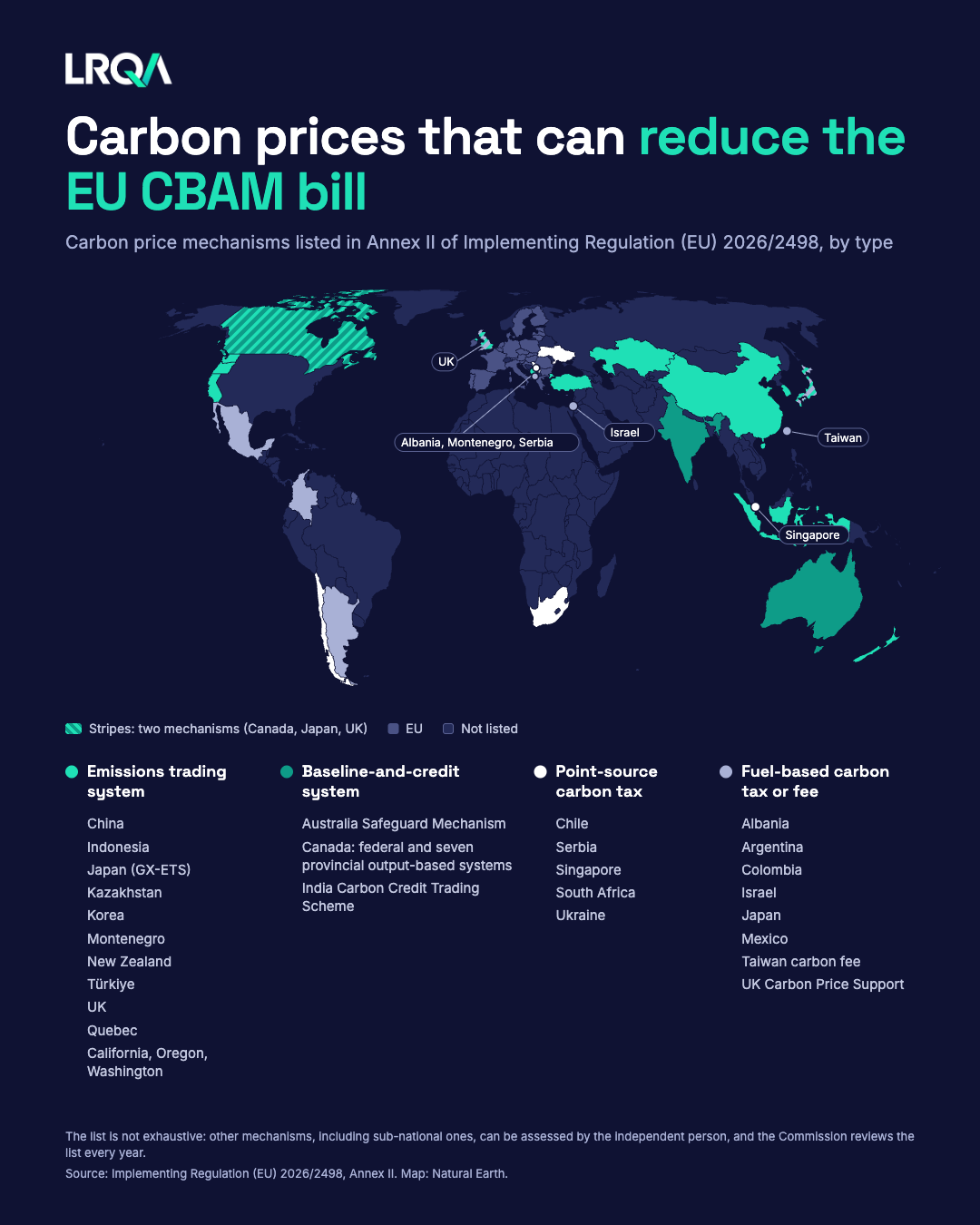
- Emissions trading systems: China, Indonesia, Japan (GX-ETS), Kazakhstan, Korea, Montenegro, New Zealand, Türkiye, the UK, Quebec, California, Oregon and Washington
- Baseline-and-credit systems: Australia’s Safeguard Mechanism, Canada’s federal and provincial output-based systems, India’s Carbon Credit Trading Scheme
- Point-source carbon taxes: Chile, Serbia, Singapore, South Africa, Ukraine
- Fuel-based carbon taxes and fees: Albania, Argentina, Colombia, Israel, Japan, Mexico, Taiwan, UK Carbon Price Support
The list is not exhaustive, other mechanism including sub-national ones can be assessed case by case.
A new document: the carbon price report
To claim a carbon price paid, the operator of the installation must now prepare a carbon price report, using the Commission’s template. An independent person must certify it, and certification is only possible once the emissions report for the same period has been verified.
Three types of data for non-EU suppliers
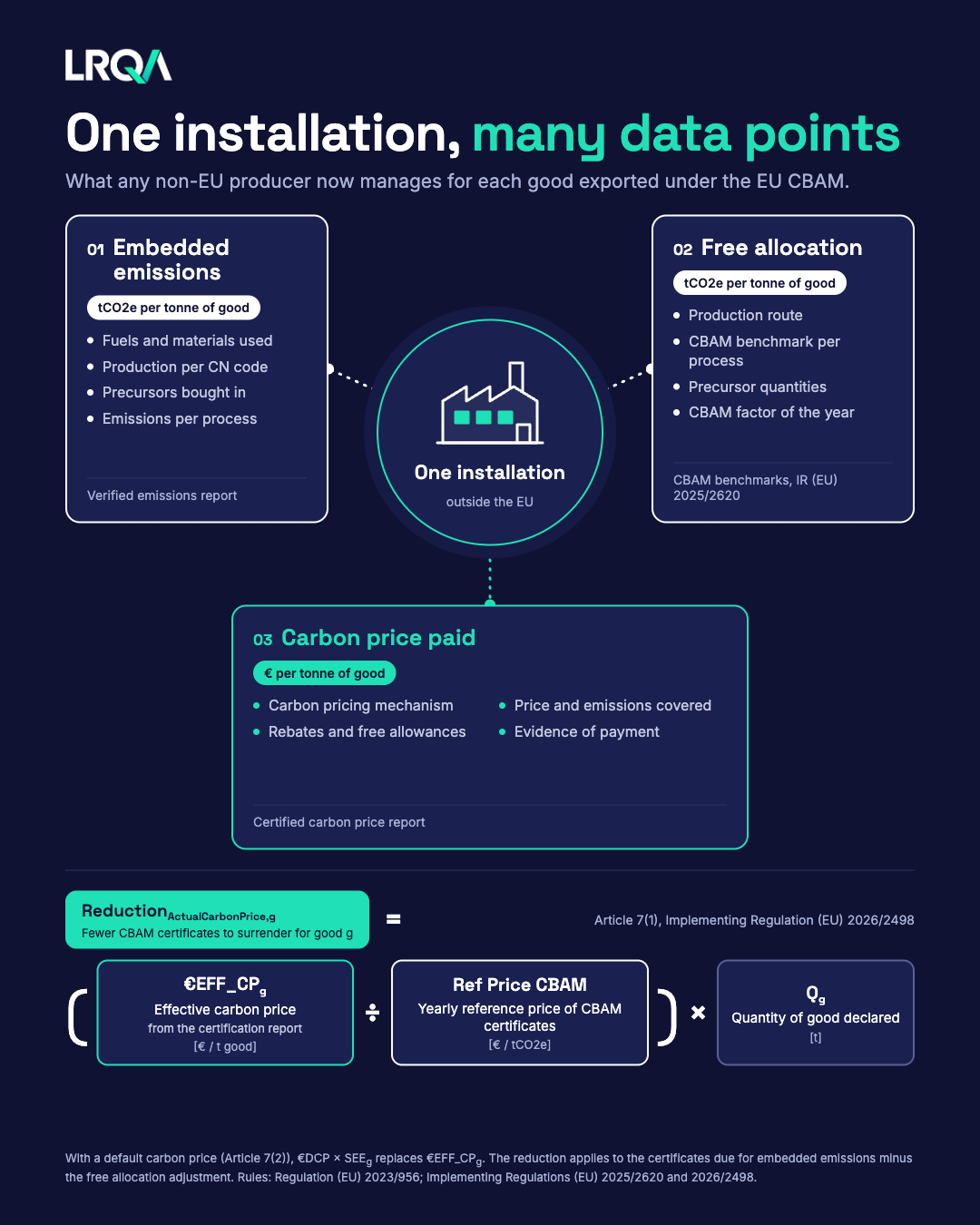
For producers of CBAM goods outside the EU, this means managing three connected sets of data for every good exported to the EU:
- Embedded emissions: fuels and materials, production per CN code, precursors, emissions per process
- Free allocation: production routes, CBAM benchmarks per process, precursor quantities
- Carbon price paid: the mechanism that applies, the price and emissions covered, rebates and free allowances, and evidence of payment
These data sets have to be consistent with each other: same reporting period, same attribution to goods. A gap in one puts the whole deduction at risk, and with it the competitiveness of the supplier’s goods on the EU market.
End-to-end CBAM support with LRQA
LRQA supports every party in the CBAM value chain:
- EU and UK importers: CBAM readiness, supplier data collection, declarations under the EU CBAM, and preparation for the UK CBAM starting in January 2027
- Non-EU suppliers: monitoring and data management, embedded emissions, free allocation and carbon price reports.
- Verification: independent verification of embedded emissions and carbon prices effectively paid.
Independence is built in: LRQA never advises on an installation it verifies.
Whether you import CBAM goods or produce them, LRQA helps you manage CBAM risk with confidence.