
Choosing vendors? Be SMART.
Our SMART inspection service helps cut down vendor selection risks.
SMART inspection service for vendor selection
What is it?
LRQA believes in adding value to the vendor selection and control process - it shouldn't be a "tick the box" exercise. After all, you'll be depending on these vendors to deliver your equipment on time and as specified.
This is why we've developed the SMART inspection service. This is a vendor assessment and audit scheme to help end-users evaluate prospective or even current vendors. We do this by developing an evaluation tool based on leading best practice, as well as customised factors you specify.
This tool not only gives you an easy to read report showing each vendor's weaknesses and strengths, but it also gives vendors a tool to target their own processes for improvement. All of this minimises risk, reduces uncertainty and improves safety, reliability and overall business performance.
SMART inspections follow three steps:
1. Assess equipment criticality.
Any risk management approach requires a detailed identification of all equipment hazards, their probability of occurrence and the consequence of the successful completion of the asset, giving a resultant equipment criticality. Equipment consequence modelling takes the following into account then produces a ranking of the equipment in criticality:
- Cost of the equipment
- Design capacity vs. required capacity
- Redundancy
- Schedule for equipment delivery and availability of vendors
- Impact of equipment failing in-service
2. Assess vendor risk.
The question, 'Which vendor to choose?' is a complicated one. To simplify the process, we develop a set of questions for each vendor based on your requirements. The questions are designed to address aspects of the vendor's capabilities, including its:
- organisation
- quality management system
- product inspection process
- equipment required for inspections
- procurement process
- in-process inspections
- workmanship
- corrective actions
- capability to deliver
Each area is thoroughly evaluated and rated according to specific criteria. The results are presented in the form of a spider diagram, identifying the vendor's strengths and weaknesses.
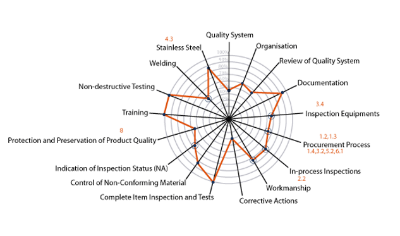
3. Create tailored Inspection Test Plans (ITPs)
Once our client chooses vendors based on our SMART inspection results, the next step is to create plans to address the weaknesses discovered in the audit process.
These Inspection Test Plans are custom built to mitigate any possible risks with each vendor. They can be designed to intervene in certain areas of the manufacturing process with appropriate skill sets.
Putting the right people in the right place at the right time can be the key to keeping any major project on time and on budget.
Supply Chain Inspection Services
CASE STUDIES
-
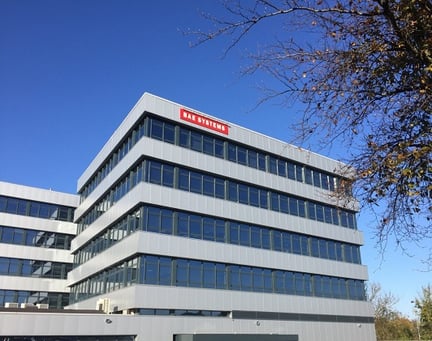
BAE Systems: Elevating operational excellence and employee well-being
Case Study
Discover BAE Systems Rochester's dedication to operational excellence as they partner with LRQA for ISO 45001 certification and...
Read more -
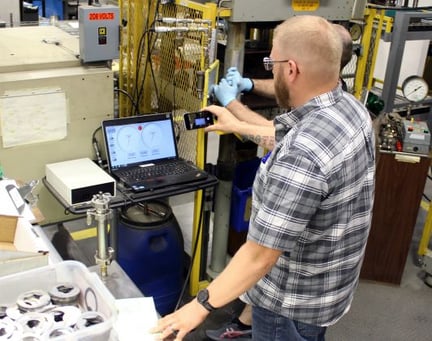
Adding flexibility through remote inspection.
Case Study
Read how our remote inspection saves one client more than 50% in inspection cost.
Read more -
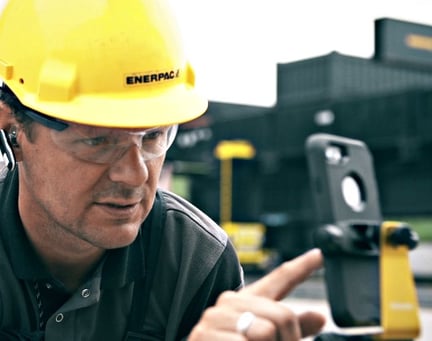
Enerpac: How remote inspection led to better customer experience....
Case Study
When Enerpac needed a more flexible inspection solution to meet its client needs, LRQA responded with remote inspection...
Read more -
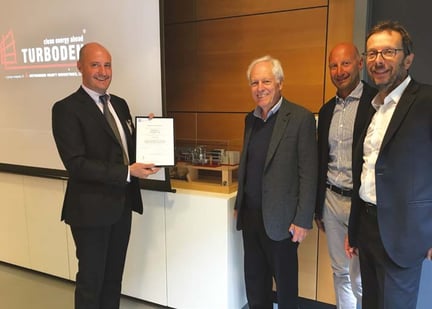
Turboden:Taking risk-based thinking into clean electricity generation.
Case Study
Taking risk-based thinking into clean electricity generation. Certification to ISO 9001:2015 to better identify risks and opportunities. Read...
Read more -
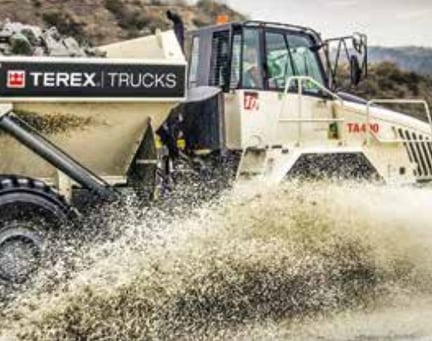
Terex Trucks: Setting industry firsts for enhanced business....
Case Study
Setting industry firsts. Certification to revised quality and environmental standards, ISO 9001:2015 and ISO 14001:2015. Read more in...
Read more -
Treating Mexico City’s wastewater
Case Study
Inspection of critical, heavy equipment for the world’s largest wastewater plant. A National Water Commission (CONAGUA) vision. Read...
Read more -
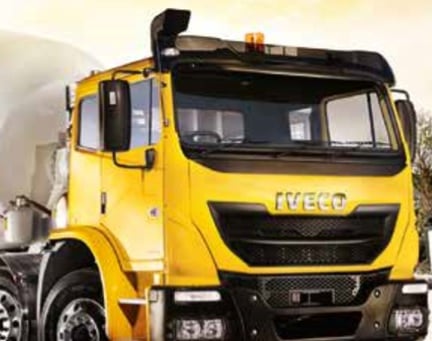
Iveco Trucks: Moving first to a new quality management...
Case Study
Certification to ISO 9001:2015 revised quality management standards for greater competitive positioning. Read more in our case study.
Read more -
Meeting global specifications
Case Study
Making heavy engineering equipment for export to 80 countries with third-party certification and conformity assessment. Read how in...
Read more -
A first for bolted joints: Hydratight and LRQA
Case Study
Setting a benchmark for training bolting flange joint technicians with an independent audit to ASME PCC-1-2013 Appendix A....
Read more

INSIGHTS
-
The importance of the right risk management partner

Article
Risk has become a sharper instrument in today’s operating environment, increasingly visible, connected and unforgiving of complacency.
Read more -
Engineering quality: Why it starts long before certification

Article
As we mark World Quality Day, it’s the perfect moment to reflect on what quality truly means today.
Read more -
The quality mindset: Connecting risk, culture and performance to...

Article
In celebration of World Quality Week, LRQA’s latest Future in Focus podcast brings together two of our leading...
Read more