HDHyundai Samho is a specialist shipbuilding and industrial plant manufacturer based in Yeongam, Jeollanam-do, South Korea. Built on world-class technical capabilities, the company constructs and manufactures large-scale vessels and industrial facilities for global markets. Today, HD Hyundai Samho is helping lead the market for eco-friendly, high-value-added vessels, guided by its mission to “pioneer the future of humanity through innovation and relentless challenge” and its vision to “realise the unlimited potential of the sea, build a sustainable future energy ecosystem and provide industrial solutions beyond the limits of time and space.”
The company is also actively working to improve safety and efficiency across its industrial operations, while advancing environmental management and responding to global decarbonisation and climate change challenges. Following its recent name change to HD Hyundai Samho, the company continues to pursue sustainable growth and play an important role in shifting the shipbuilding industry towards a more environmentally focused future.
What is ZWTL certification?
ZWTL(Zero Waste to Landfill) is an approach that focuses on minimising the amount of waste from a site that is sent to landfill. Instead, waste is managed through alternative routes such as reuse, recycling, composting and energy recovery. ZWTL certification is used to verify these activities and outcomes against objective criteria, helping organisations demonstrate their waste reduction efforts more transparently.
Background
Since declaring its commitment to carbon neutrality in 2023, HD Hyundai Samho has continued to expand its activities to support energy transition and sustainable management. From 2025, the company began introducing solar power on a larger scale and applying the renewable energy generated directly to its operations, as part of its transition towards a more environmentally focused shipyard.
At the same time, the need for objective verification aligned with global standards has increased in the area of circularity. In particular, HD Hyundai Samho pursued Zero Waste to Landfill certification to respond to ESG expectations from shipowners and classification societies, and to demonstrate the transparency and reliability of its waste management system.
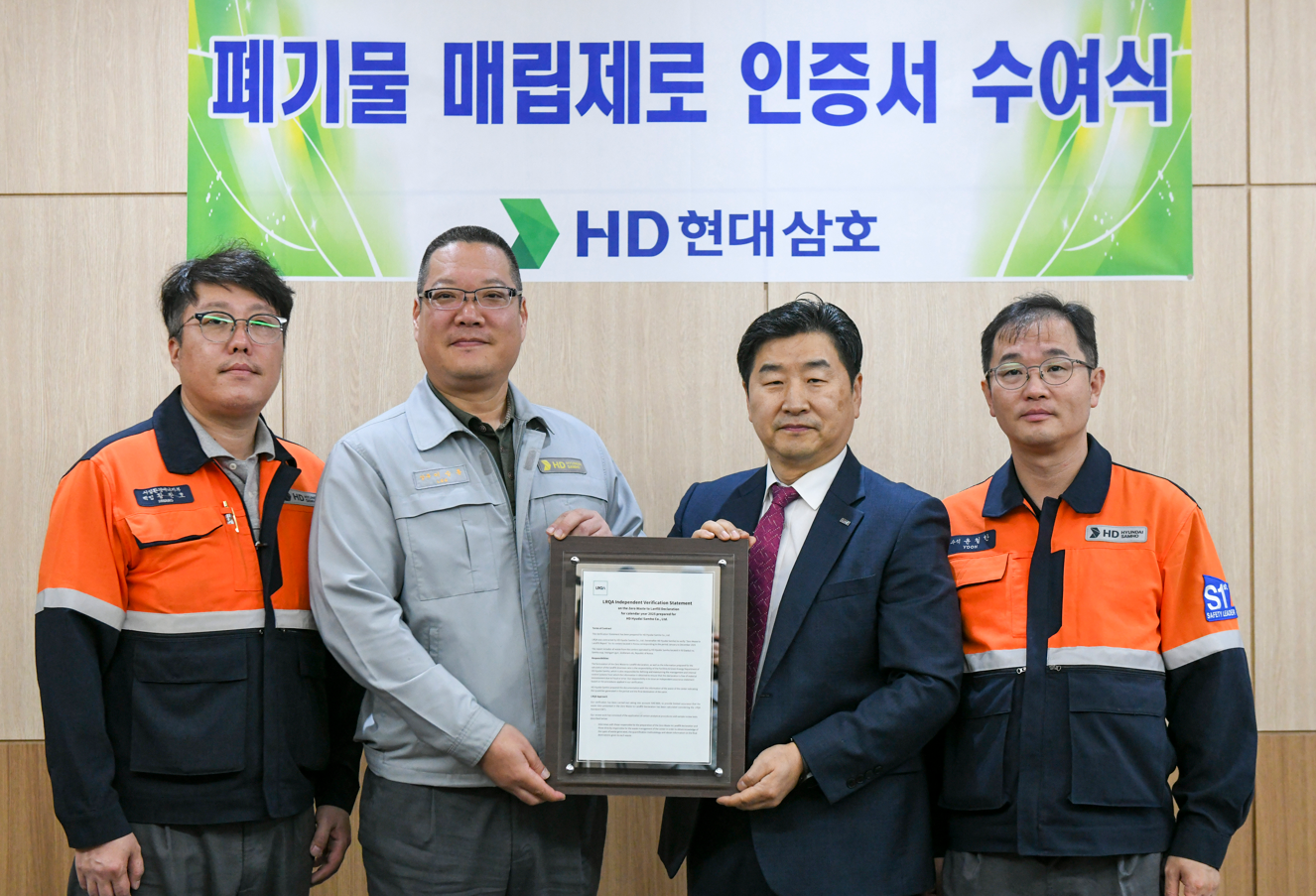 [Photo: HD Hyundai Samho Zero Waste to Landfill (ZWTL) certification award ceremony]
A journey built on data and site-wide collaboration
As part of its preparation for ZWTL certification, HD Hyundai Samho reviewed the full waste management process, from waste generation, collection, sorting and storage to removal and final treatment. To objectively demonstrate its waste diversion rate, the company focused on verifying the accuracy and traceability of data, including waste volumes by item, treatment records, recycling outcomes and resource recovery data.
Waste management cannot be achieved by the environmental team alone. HD Hyundai Samho has been working to minimise waste generation and identify recycling opportunities through a collaborative approach involving design, materials, on-site production teams and partner companies. Its internal real-time monitoring system also provided an important foundation, with designated waste discharge owners assigned to each worksite and real-time communication established between site teams and management departments.
The company also continued to strengthen waste separation and resource recovery through site-focused improvements, including enhanced paint can collection processes, an incentive programme for voluntary plastic returns and a system for issuing reusable materials recovered through waste sorting. Key circularity activities, such as scrap metal separation and waste Styrofoam collection, were supported by both the actions of on-site workers and the continued improvement of data management by the responsible teams.
Turning waste management data into verified performance
Through the ZWTL certification process with LRQA, HD Hyundai Samho was able to independently verify its complex waste management system and circularity performance, reflecting the unique characteristics of the shipbuilding industry. LRQA assessed key activities such as the company’s real-time waste tracking system and the recovery of resources from scrap metal and waste Styrofoam against independent criteria, helping HD Hyundai Samho demonstrate its waste diversion performance with confidence.
Building on this certification, HD Hyundai Samho plans to continue its efforts towards net zero and a fully circular shipyard. The company aims to apply AI technology to its real-time waste tracking system to improve waste generation forecasting and management efficiency. It also plans to expand its solar power facilities and identify additional areas of unrecycled waste, supporting further progress towards practical landfill reduction and improved circularity rates.
Contact to LRQAPDF Download (KR)