

On COP31’s Zero Waste Day, Roxby Hartley, Ph.D., Climate Risk Director at EcoEngineers, an LRQA company, explains why cutting methane is the fastest climate win available, and why it now needs binding rules to deliver it.
Methane is on the agenda at COP31. This graph shows why it matters.
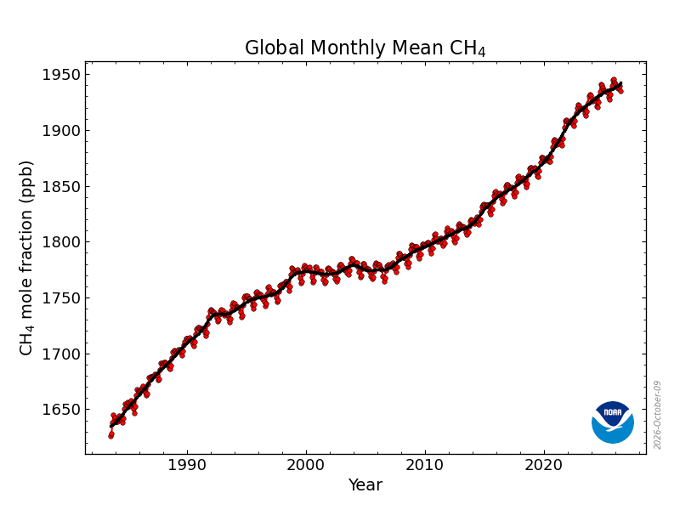
The graph shows globally averaged, monthly mean atmospheric methane abundance determined from marine surface sites. Source: National Oceanic and Atmospheric Administration (NOAA).
We tend to talk about climate change over the next century. But we urgently need to slow warming now. What happens over the next 10, 20 and 30 years matters enormously. Methane has an atmospheric lifetime of around 12 years, but that short lifetime is exactly why its near-term impact matters. Over 20 years, a tonne of methane has roughly 80 times the warming impact of a tonne of carbon dioxide (CO₂). Stretch the accounting period to 100 years and that falls to around 27 to 30 times the warming impact.
Methane is one of the emissions we can do something about relatively quickly. Fix leaks. Stop venting. Capture landfill gas. Improve manure management. Properly plug leaking abandoned oil wells. Turn captured biogenic methane into renewable natural gas (RNG).
Much of the technology already exists. Many methane reductions are low-cost, and some energy-sector measures can even have negative net costs because they prevent the loss of a valuable product.
There is another reason for urgency. A warmer, wetter world can increase natural methane emissions from wetlands, while thawing permafrost can unlock huge stores of previously frozen carbon.
More warming leads to more methane release, which leads to more warming.
I am personally terrified of that climate feedback loop. We can't easily stop wetlands emitting methane or permafrost thawing. But we can reduce the methane emissions we control.
Turning waste into value
Capturing methane can pay. At EcoEngineers, we’ve worked on many landfill and dairy projects where methane is collected, cleaned and injected into the gas grid as RNG. Programmes such as California’s Low Carbon Fuel Standard (CA-LCFS) have made that economically attractive, turning a waste stream into a revenue stream.
Some of the cheapest wins are simpler still. Plugging an abandoned oil well can take little more than concrete and careful monitoring afterward. The harder tasks are figuring out who is responsible for wells that have changed hands many times and measuring the baseline well enough to prove the benefit.
What I’d like from COP31
The Global Methane Pledge calls for a 30% reduction by 2030. Current national plans are projected to deliver only about 8%. That simply isn't enough. COP31 should focus on measurement, accountability and deep, rapid reductions in methane emissions.
If we want to slow warming in the decades that matter most, rapidly reducing methane is one of the most important things we can do.
We need countries to work towards an agreement modelled on the Montreal Protocol, which phased out ozone-depleting chemicals through binding commitments that every signatory had to meet.
The clock is ticking.