Support for tripling nuclear power keeps growing. LRQA’s Simon Emeny, Strategic Markets Director for Nuclear, asks whether the world can build fast enough to deliver it.
At COP28 in Dubai, 25 countries backed a goal to at least triple global nuclear capacity by 2050. Since then, the coalition has grown to 39, with China, Brazil, Italy and South Africa among the latest to sign. Political support for nuclear is stronger than it has been in a generation.
The fleet itself tells a different story. Global nuclear capacity was around 400 GW in 2020, the baseline for the pledge. Today, according to the World Nuclear Association, it is still around 400 GW. New reactors have come online, but broadly at the pace older ones have retired.
The scale of the task
Tripling means reaching around 1,200 GW by 2050. Allowing for the reactors expected to still be running then, the world needs to add roughly 800 GW in 24 years. That is about 33 GW a year, or the equivalent of connecting around ten Hinkley Point Cs to the grid every year until 2050. Hinkley Point C itself is not yet connected.
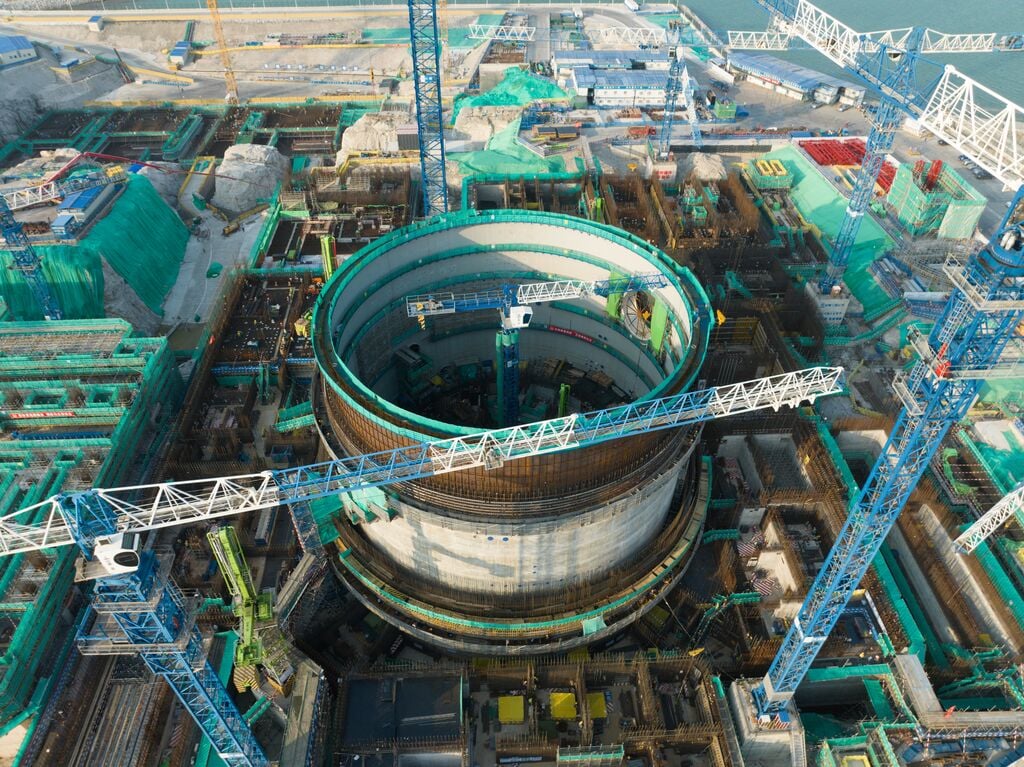
There is real progress in the pipeline. According to the IAEA, 77 reactors totalling around 81 GW are under construction, and 11 reactors started construction in both 2024 and 2025. But that pipeline is concentrated in a small number of countries. China alone accounts for 36 reactors and around 39 GW, roughly half the world total.
Beyond that, the picture becomes less certain. The World Nuclear Association counts around 105 GW of planned reactors expected to be operating by 2041, and a further 294 GW proposed by 2050. Even so, around 550 GW of the capacity governments are targeting isn’t yet linked to any specific project. And even the IAEA’s most optimistic scenario reaches around 1,045 GW by 2050, short of tripling.
Our analysis shows that progress has been made on financial models, one of the biggest risks to delivery. But the supply chain is waiting for firm orders before it invests in the capability and capacity needed. The longer those orders take, the more capacity will need to be connected each year to reach the 2050 goal.
A delivery problem
The ambition is there, and the barriers are increasingly practical. Nuclear projects depend on supply chains that can manufacture components to exacting standards, a workforce with specialist skills and quality systems that hold up over projects lasting a decade or more.
That capacity is limited. The pool of suppliers qualified to nuclear standards is small, many skilled workers are approaching retirement and quality failures discovered late in a project are among the most common causes of delay and cost overrun. Scaling all of that several times over, across many countries at once, is the real challenge behind the pledge.
What COP31 could do
The countries backing the pledge could treat delivery capacity as part of the commitment. That means investing in the supply chain and skills that new build depends on, so more manufacturers can qualify to nuclear standards and more people can be trained to build and inspect plants.
It also means more cooperation between regulators and on standards, so that a component qualified in one country doesn’t have to go through the whole process again in another. And it means finance that reflects the long timescales of nuclear projects.
Turning ambition into steel and concrete
At LRQA, we work with organisations across the nuclear supply chain, and we see both the appetite to build and the strain on the systems needed to do it safely. Getting quality right first time is one of the most effective ways to bring schedules and costs down.
The tripling pledge has done its job in building political support. Delivering it will depend on whether the world can build the supply chains, skills and quality systems to match.
Sources: IAEA Power Reactor Information System (PRIS); IAEA, Energy, Electricity and Nuclear Power Estimates for the Period up to 2060; World Nuclear Association, World Nuclear Outlook Report 2026.