

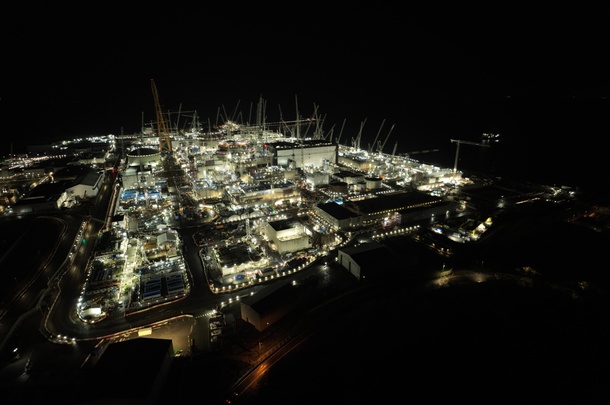
The polar cranes at Hinkley Point C are among the most important pieces of nuclear lifting equipment on site. Essential for nuclear island construction, reactor operations and future refuelling activities, these safety-critical cranes are designed to operate throughout the station's lifecycle.
LRQA worked alongside the Hinkley Point C project team to provide independent lifting equipment inspection, testing oversight, commissioning support and thorough inspection services, helping ensure the cranes were safe, compliant and ready for operation. 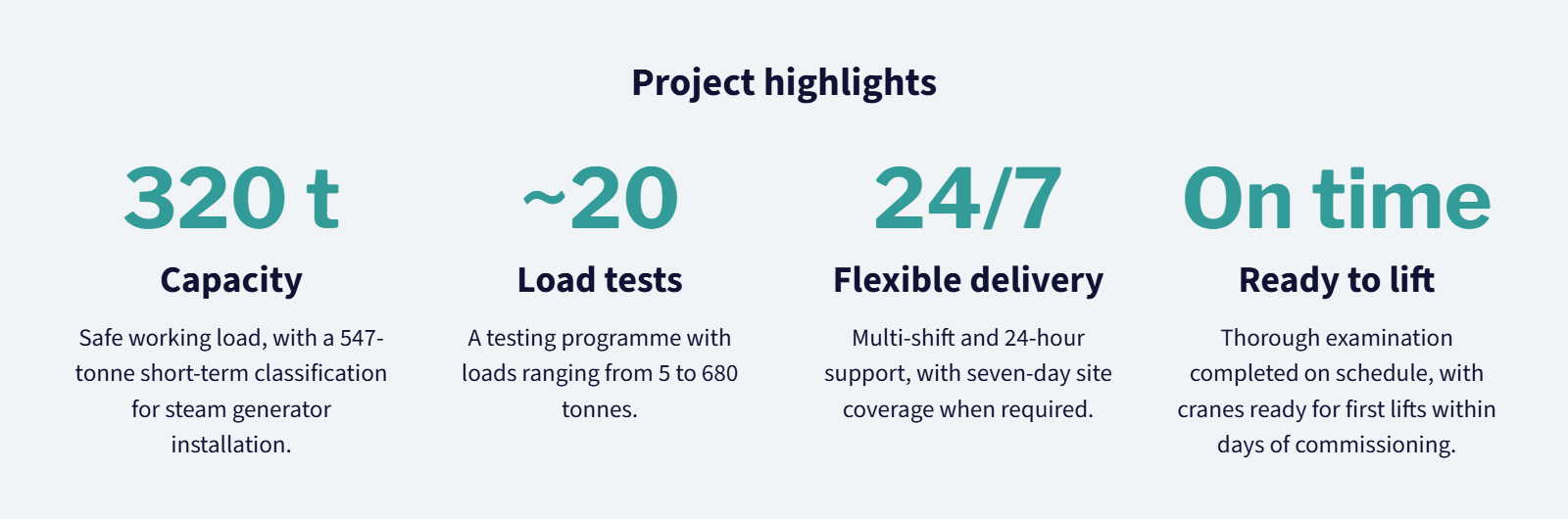
Supporting a nuclear asset designed to last generations
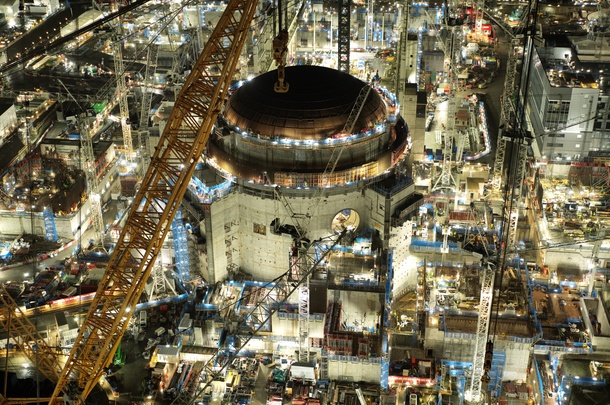
The two polar cranes will remain inside the reactor buildings throughout the operational life of Hinkley Point C and into eventual decommissioning. During construction, the cranes are used to install critical primary-circuit components. Once the plant enters service, they will support maintenance, reactor operations and refuelling activities.
Each crane has a 320-tonne safe working load, making them among the most significant lifting assets within the nuclear facility.
Their scale presented major logistical challenges from the outset. Main beams measuring approximately 45 metres were transported from Switzerland via the Rhine, Rotterdam, Avonmouth and Combwich Wharf before arriving on site. A dedicated assembly facility was then constructed at Hinkley Point C to enable ground-level assembly, testing and inspection prior to final installation.
For the project team, every decision was guided by four priorities:
- Safety
- Quality
- Schedule
- Cost
This approach helped manage a complex nuclear construction programme involving multiple contractors, specialist disciplines and critical project interfaces.
The challenge: Assuring safety-critical nuclear lifting equipment
The Hinkley Point C polar cranes combine exceptional size, technical complexity and the stringent requirements of a nuclear environment.
Assembly and commissioning required tens of thousands of labour hours, including extensive work at heights of 30 to 40 metres. Multiple disciplines, including civil construction, scaffolding, coatings, electrical installation and commissioning teams, needed to coordinate activities within a demanding programme schedule.
Because the cranes will ultimately perform safety-critical lifts above reactor systems, independent third-party inspection and assurance were essential.
Rather than leaving inspection and certification until project completion, assurance activities needed to be integrated into the assembly, testing and commissioning programme from the beginning. The project also faced a compressed timeline, with the first crane required for operational lifting shortly after commissioning and removal of test weights.
The solution: Early engagement and embedded assurance
Early involvement during test planning
LRQA became involved before site activities accelerated, supporting the development of the load-testing strategy and test-weight design.
This early engagement enabled alignment on compliance requirements, examination expectations and testing methodologies, ensuring that verification activities were built into the programme from day one.
The resulting test programme included approximately 20 load tests ranging from 5 tonnes to 680 tonnes.
Independent inspection throughout assembly and commissioning
LRQA's competent-person team provided independent oversight during key stages of crane assembly, testing and commissioning.
- Inspection activities included:
- Verification of principal component assembly
- Inspection of main quadrilateral structural elements
- Oversight of circular runway installation
- Rope reeving and drum arrangements
- Static load testing
- Dynamic load testing
- Final thorough examination and certification activities
Regular communication supported efficient delivery while maintaining the independence expected of a third-party inspection body. Weekly coordination meetings, daily planning discussions and structured handovers enabled progress without compromising impartiality.
Flexible support aligned to project schedules
The commissioning programme included extended working periods, night shifts and around-the-clock testing activities.
To support these requirements, LRQA implemented a flexible inspection model featuring:
- Seven-day coverage
- 24-hour support when required
- Shift-based handovers
- Digital and face-to-face coordination
- Dedicated competent-person resources for critical testing activities
This ensured independent inspection coverage was available whenever key assurance activities took place.

The quality of communication between customer, contractor and within the LRQA team was exceptional. Regular daily meetings ensured that critical information was consistently available, enabling rapid decision making.
Phillip Coyne - In Service Surveyor, LRQA
Results: Operational readiness with reduced risk
By embedding assurance into the programme from an early stage, the project team gained confidence that inspection and compliance requirements were being addressed throughout assembly and commissioning.
This proactive approach reduced the risk of certification delays and enabled a smooth transition from commissioning to operational use.
Knowledge gained during Unit 1 was subsequently applied to Unit 2, helping improve efficiency across the wider programme. Refinements including ground-level assembly, more complete pre-installation commissioning and improved sequencing contributed to an estimated 30% reduction in time and cost between the two units.
LRQA was also able to focus inspection and surveillance activities more effectively using lessons learned from the first crane.
Most importantly, the cranes were assembled and commissioned safely and were able to move rapidly into operational service supporting reactor-building installation activities.
If you deliver the right quality, you don't have to do rework. Then you can optimise the schedule, and the cost will come down.
Simon Stacey - Hinkley Point C Project Team
Key lessons for future nuclear construction projects
The Hinkley Point C polar crane programme demonstrates the value of integrating independent inspection, lifting equipment assurance and compliance planning early in major nuclear construction projects.
Key lessons include:
- Engage independent inspection bodies, like LRQA, early in project planning.
- Integrate assurance requirements into engineering, testing and construction programmes.
- Establish consistent communication through daily planning and weekly coordination.
- Maintain the independence of competent-person inspections while encouraging collaboration.
- Apply lessons learned across subsequent project phases and units.
- Build testing, certification and examination requirements into schedules from the outset.
Independent assurance for complex nuclear lifting equipment
As new nuclear projects continue across the UK and Europe, the Hinkley Point C polar crane programme highlights how early assurance, rigorous third-party inspection and collaborative delivery can support safe and efficient project execution.
By combining early-stage technical input, flexible inspection support and rigorous independent oversight, LRQA helped reduce certification risk, protect the project schedule and give the Hinkley Point C team confidence that these safety-critical lifting assets were ready for operation.
One connected partner across the nuclear lifecycle
LRQA supports the nuclear sector across the entire lifecycle – providing independent assessment, inspection, cyber security and assurance services for new-build programmes, operating plants, SMR developers and the supply chains behind them.
Explore our nuclear assurance services