

Grievance mechanisms for global supply chains
Scalable, transparent and independent grievance mechanisms
Delivering a transparent, independent and trusted channel
Our global grievance mechanisms offer a transparent, independent, and safe channel for workers to report health, safety, social/labor, and environmental issues anytime, anywhere.
Scalable from single sites to entire sectors and geographies, our model aligns with international frameworks like UNGPs and CSDDD.
Individuals are supported in local language with familiar and accessible channels, staffed by trained operators who understand local contexts and are trusted by rightsholders.
We identify and address issues, providing actionable information and on the ground support.
Our data-driven approach enables real-time monitoring, tracking, and reporting of grievances to support risk assessment, strategy, and sustainability reporting needs.
Grievance mechanisms help cover ‘blind spots’ that audits, SAQs and other risk monitoring tools cannot reach in real time.
Grievance mechanisms for global supply chains approach

Digital dashboard
Tracks, monitors and reports live grievance data through an interactive perform, allowing clients to conduct in-depth risk analysis.

Multi-channel support
Accessible to workers through toll-free numbers, social media, instant messaging, webform, or apps to ensure barriers to reporting are minimal.

Live operators
Who are trusted by workers, gather information and support with case handling and remediation.

Scalable global solutions
Accessible in over 15 languages across commodities and geographies.

Dedicated team of trainers
Who support building awareness and trust, as well as encouraging adoption.
 Specialist support
- To remediate complex high-risk issues including forced labor, child labor, migrant worker rights and discrimination.
Worker voice in action: Introducing Mithuru Saviya
Mithuru Saviya is the latest addition to LRQA's Global Grievance Mechanism offering, providing workers in Sri Lanka with trusted and accessible channels to raise workplace concerns. The launch demonstrates how locally grounded grievance mechanisms can help organisations strengthen worker engagement, improve visibility of supply chain risks and support access to remedy.
Discover how Mithuru Saviya works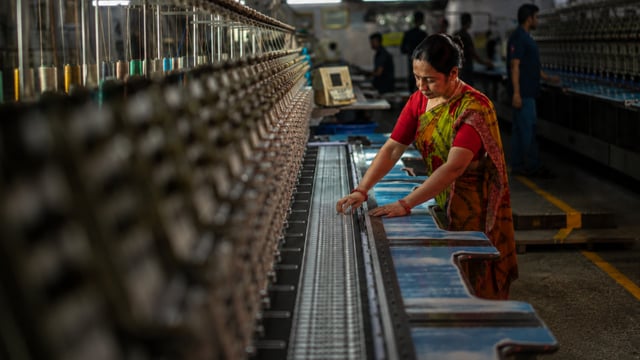
Why partner with us?
LRQA supports businesses to implement grievance mechanisms for global supply chains. As a trusted expert with over a decade of experience, we offer a confidential and independent mechanism for workers to report issues and receive remediation, while clients recieve critical data to support proactive risk management and due diligence.
Our people
LRQA experts work closely with local partners to ensure that our Grievance Mechanisms are in line with international best practices and emerging standards. With over 25 years of experience, identifying and remediating risk is in our DNA.

Proprietary tools
Our proprietary research and analytical tools, including our Grievance Mechanism Interactive Data Dashboard, are used globally to capture and analyse grievance data, helping organisations identify risk, hear directly from workers, and generate insight tailored to industry and geography.

Experience
Our evaluation is based on decades of experience not only assessing current states, but also designing and implementing long term programs.

Expertise
We engage with civil society and other experts to develop appropriate methodologies, ensuring our due diligence tools address concerns in a sensitive and culturally appropriate manner. Providing pragmatic, resource-effective and scalable solutions.

Related solutions
Explore our Consulting Services portfolio and find out how we can partner with you to solve ESG challenges
INSIGHTS
-
New data, new standards, new expectations: the state of...

Article
New World Health Organization (WHO) data, a wave of revised food safety standards and a shifting hazard landscape...
Read more -
Five things companies overlook when preparing for CBAM

Article
Discover five common mistakes companies make when preparing for CBAM, from supplier data gaps and carbon cost exposure...
Read more -
Nuclear and energy security in the Middle East

Article
Explore how nuclear energy is reshaping energy security in the Middle East, driven by rising demand, geopolitical pressure...
Read more -
Scaling Supply Chain Impact | Dr Siva Pariti

Article
Dr Siva Pariti shares insights on improving supply chain impact through integrated approaches to carbon, chemicals and water,...
Read more -
ISO 22163 Explained: Why the rail industry is embracing...
Article
Discover why ISO 22163 is becoming the global standard for rail quality management and what it means for...
Read more -
Axios Supply Chain Attack: What happened and how to...

Article
Two compromised Axios npm versions installed a stealth RAT via a malicious dependency. Learn how the attack worked,...
Read more -
Climate ambition isn’t enough: the rise of evidence-led decarbonisation...

Article
Supply chain decarbonization is entering a new phase. LRQA’s Risk Outlook 2026 shows why the challenge is no...
Read more -
Forced labour import bans are now a board level...

Article
Forced labour regulation has shifted rapidly from a defined compliance requirement into a decisive factor in how goods...
Read more -
Food safety oversight should follow risk

Article
In part three of the food safety risk insights series, we explore how food safety oversight can better...
Read more